
Beyond Renting: The Blueprint to Wealth and Real Estate Success
In our last few posts, we broke down how to get your money right—from understanding compound interest to diversifying your portfolio with stocks and bonds. We’ve discussed setting up a solid defensive line with your emergency fund.
But as a former cornerback, I can tell you that playing purely on defense won’t win the game. You have to put points on the board. Now, it’s time to talk about offense. It’s time to talk about the asset class that has created more millionaires than almost any other: Real Estate.
If stocks and bonds are the high-speed processing equipment in a biotech lab, real estate is the actual facility. It’s tangible, it’s foundational, and it requires a specific Standard Operating Procedure (SOP) to run efficiently.
Today, we are diving into Part 5 of our blueprint: Homeownership and using real estate to bridge the wealth gap.
The Benefits of Homeownership: Total Control, Equity, and Tax Breaks
In my day-to-day as a biotech supervisor, I know that if you don’t control the environment, you can’t guarantee the results. Renting is like working in someone else’s lab—they set the rules, they can raise the rent, and every dollar you spend is an expense that disappears forever.
Homeownership changes the game. It gives you the stability to build a life on your own terms—whether that’s putting down roots, having a dedicated space to recover after training for a sprint triathlon, or simply having a home base to return to after traveling the world with your wife.
But financially, the biggest advantages are Building Equity and Tax Benefits.
- Building Equity (Forced Savings): Equity is your “savings account within your house.” It’s the difference between what your home is worth and what you owe on the mortgage. Every month when you pay your mortgage, a portion goes toward the principal. You are essentially paying yourself. As the value of the home appreciates over time, your equity grows passively.
- The Tax Shield: Here is a massive benefit that isn’t talked about enough. Owning real estate comes with serious tax deductions. You can deduct the interest you pay on your mortgage and your local property taxes from your taxable income. This means you get to keep more of the money you make. That’s extra capital you can use to fund your next investment, take that dream vacation, or push toward early retirement.
Navigating the Mortgage Process: Validating Your Financial Data
You can’t run a production batch until the data is validated, and getting a mortgage is no different. It’s a process, but if you follow the checklist, it’s completely manageable.
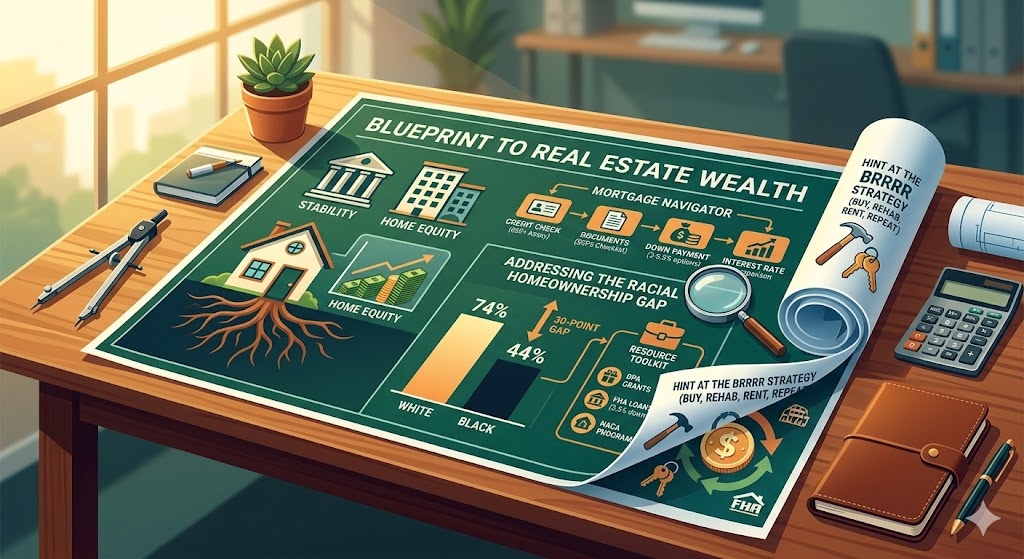
Here is the SOP for navigating the mortgage process:
- Credit Check: This is your initial assay. Lenders want to see how you handle debt. Aim for a score of 620 or higher for conventional loans, though government-backed loans can go lower.
- Gather Your Documents: Lenders need verification. You’ll need paystubs, W-2s, tax returns, and bank statements.
- The Down Payment Myth: You do not need 20% down. While 20% helps you avoid Private Mortgage Insurance (PMI), many first-time buyer programs require as little as 3% to 3.5% down. In fact, if you are in a rural area you may even qualify for a 0% down USDA like I did for my first house.
- Interest Rates: Think of this as the “efficiency loss” in your process. A lower rate means less money spent on interest over the life of the loan. Keep your credit high and shop around with different lenders to get the best deal.
Addressing the Racial Homeownership Gap: Leveling the Playing Field
We cannot talk about building wealth among underrepresented peoples without mentioning the Black community and addressing the systemic barriers that have kept us behind the starting line. History includes redlining, discriminatory lending, and appraisal bias that have made it harder for underrepresented minorities to own homes.
The data from the U.S. Census Bureau and recent economic reports highlight a persistent, staggering gap:
- White homeownership rates currently sit around 74%.
- Black homeownership rates are approximately 44%.
That is a 30-point gap. Because homeownership is a primary driver of intergenerational wealth, this disparity contributes significantly to the overall wealth gap in America.
Taking Action and Accessing Resources Knowing the data is the first step toward optimizing the process. We have to be proactive and run a corrective action plan. Fortunately, there are resources designed to help us close this gap:
- Down Payment Assistance (DPA) Programs: Almost every state, and many cities, offer grants or forgivable loans to help first-time homebuyers cover down payments and closing costs.
- FHA Loans: Backed by the government, these loans are great for first-time buyers because they allow for lower credit scores and a down payment of just 3.5%.
- NACA (Neighborhood Assistance Corporation of America): This is a non-profit that offers an incredible program with no down payment, no closing costs, no PMI, and a below-market interest rate for low-to-moderate income earners. It requires putting in the work, but the payoff is massive.
The Next Level: From Homeowner to Investor
Getting into your first home is a championship win. It gives you stability and starts the equity snowball rolling.
But what if you want to use real estate not just to house yourself, but to multiply your wealth? In our industry, we don’t just use equipment once and throw it away; we sanitize, validate, and reuse. We automate systems to maximize output.
In a later post, I’m going to show you how to take a simple FHA loan and use an advanced investment technique that can accelerate your wealth building. We are going to talk about a specific strategy to Buy, Rehab, Rent, and Repeat—supercharging that compounding snowball we’ve been building.
P.S. Every solid wealth-building playbook needs a few quick, easy wins. While we’re focusing on the big moves like real estate, here’s a simple way to put some cash back in your pocket right now. You can get a free $80 bonus just for creating an account with Capital One Shopping to automatically find discount,cashback on things you already buy. Consider it an easy $80 to drop straight into your emergency fund or down payment savings!
 Wealth, Health,& Fitness